
A precision CNC machine shop in Los Angeles, running since 1986.
Forty years on the same South Bay floor, machining aerospace, defense, medical and industrial parts. Standard production tolerances of ±.0005″ on turned diameters and ±.001″ on milled features, with critical features held to ±.0001″ where the print requires it.
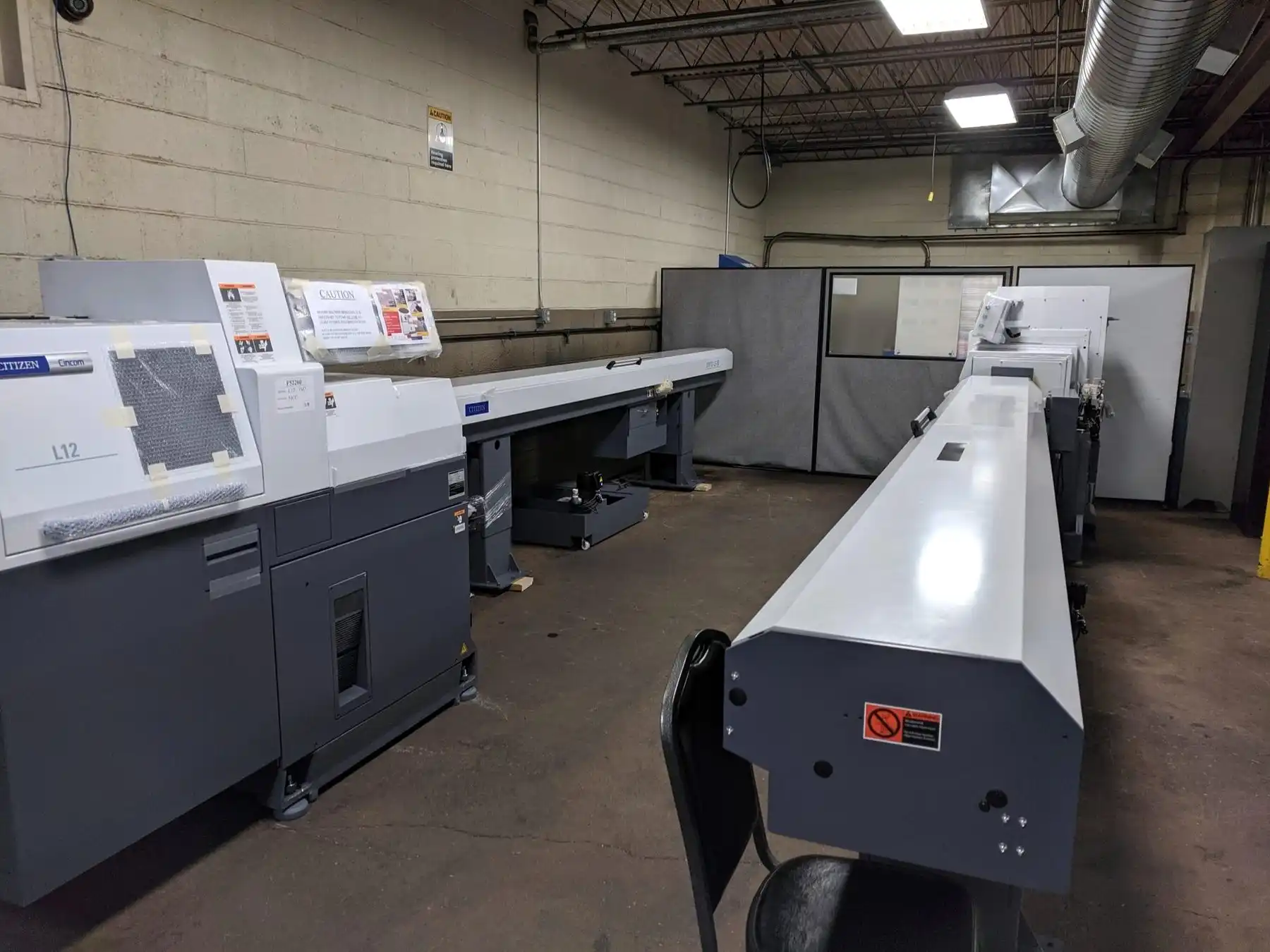
RJ Enterprises machines precision components from a facility in Gardena, minutes from the aerospace corridor around El Segundo, Torrance and Long Beach. Local customers drop off prints, walk the floor, and see the machine their part will run on before they release a purchase order.
Thirty-five CNC machines cover milling, 5-axis, Swiss-type turning and CNC turning, with a climate-controlled inspection lab holding a ZEISS ACCURA CMM. Programming, machining, inspection and most secondary operations happen in the same building, so a schedule change is a conversation rather than a chain of vendors.
We are certified to AS9100D and ISO 9001:2015 under DNV, with full material and process traceability, first-article reporting in AS9102 format, and documented in-process control on every production release.
CNC Milling
Ten vertical machining centers running prototype through production quantities, with milled features held to a standard ±.001 in and critical callouts to ±.0001 in where the print requires it.
5-Axis Machining
Five simultaneous 5-axis machining centers for impellers, contoured housings, brackets and any part where every additional setup is another chance to stack error.
Swiss Turning
Sixteen Swiss-type lathes — Citizen L12, L20 and L32, Citizen/Miyano BNX and BNA, Tsugami S205-II and B0325V-II — holding ±.0005 in on turned diameters with as-machined finishes that rarely need a secondary operation.
CNC Turning
Eight turning centers, several with Y-axis and sub-spindle, so a chucked part is turned, milled, drilled and finished on the back side without leaving the machine.
Inspection & Metrology
A climate-controlled inspection lab with a ZEISS ACCURA CMM, a Mitutoyo Crysta-Apex EX, four Keyence IM image dimension systems and a fully calibrated gage library.
Secondary Operations
Tapping, drilling, grinding, deburring, assembly and laser marking in-house, with anodize, passivation, plating, heat treat and NDT coordinated through approved sources.
Wire EDM
Wire electrical discharge machining for tight-profile forms, keyways, slots and tabs in hardened tool steel and other conductive materials that resist conventional cutting.
Sinker EDM
Sinker (ram) EDM sinks a shaped electrode into the workpiece to produce blind cavities, internal splines and forms — and to remove broken taps and drills without scrapping the part.
Local delivery across the South Bay.
Gardena, California. Domestic shipping nationwide, with local pickup and delivery throughout Los Angeles County.
- Gardena
- Torrance
- Carson
- Compton
- Long Beach
- El Segundo
- Hawthorne
- Inglewood
- Redondo Beach
- Downey
- Santa Fe Springs
- Greater Los Angeles
CNC Machine Shop Near Torrance
Ten minutes from Torrance's aerospace corridor, for structural hardware and Swiss-turned components.
CNC Machine Shop Near Long Beach
A short run down the 710 for Long Beach's port, marine and oil & gas fabrication customers.
CNC Machine Shop Near El Segundo
Fifteen minutes from the LAX aerospace and defense cluster, with pickup and delivery on prototype and low-volume runs.
CNC Machine Shop Serving Orange County
Irvine, Anaheim, Santa Ana and Huntington Beach, with consolidated shipments on production programs.
Los Angeles, answered plainly.
What is a typical lead time for machined parts?
Standard production lead times generally run two to four weeks depending on process, quantity and material availability, with expedited scheduling available for urgent releases — ask when you submit your RFQ.
Do you offer pickup and delivery across Los Angeles County?
Yes. From our Gardena facility we run routine local pickup and delivery throughout Los Angeles County — the South Bay, LAX-area aerospace corridor, and downtown and eastern LA industrial accounts — alongside domestic shipping nationwide.
What certifications do you hold?
We are certified to AS9100D and ISO 9001:2015 under DNV, with material traceability, AS9102 first article reporting and documented in-process inspection built into every production release.
What tolerances can you hold?
Standard production tolerances of ±.0005″ on turned diameters and ±.001″ on milled features, with critical features held to ±.0001″ where the print requires it. Critical geometric features are verified against print datums on our ZEISS ACCURA CMM.
Can you quote from a PDF drawing, or do you need a 3D model?
Either works. A 2D PDF with GD&T is sufficient to quote and machine most parts; a 3D model (STEP, IGES or native CAD) speeds up programming and is preferred when one is available, but it is not required to get a quote.
Do you take on low-volume or prototype work, or only production runs?
Both. Single-digit prototype quantities run on the same machines and under the same quality system as full production releases, which lets a part move from first article to production without changing shops.