
Complex contours in fewer setups.
Five simultaneous 5-axis machining centers for impellers, contoured housings, brackets and any part where every additional setup is another chance to stack error.
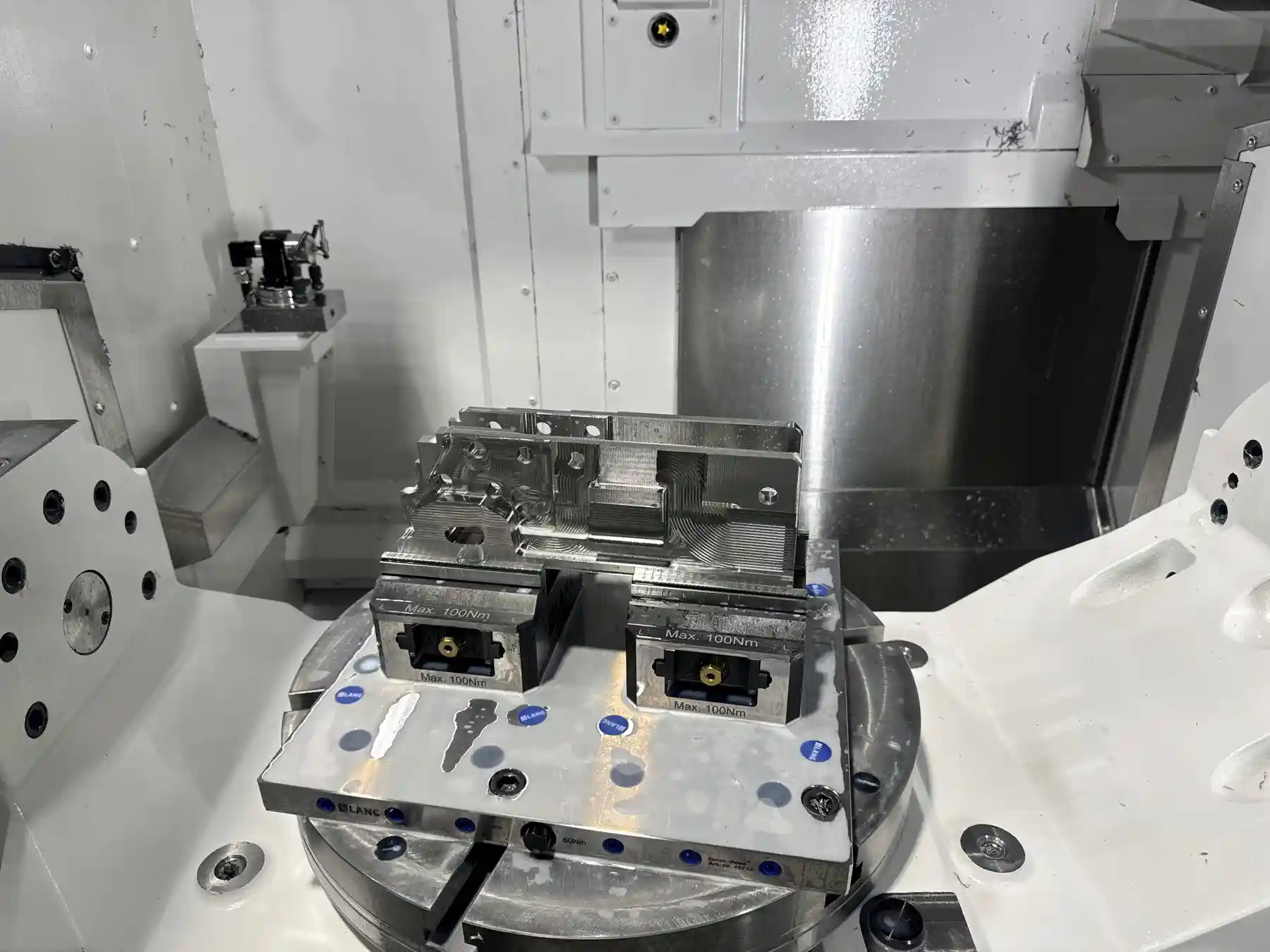
5-axis work exists to remove setups. A part that needs five faces machined can be fixtured once, indicated once, and cut in one continuous program — so the relationship between features is held by the machine rather than reconstructed by an operator. On tight geometric callouts, true position and concentricity in particular, that difference is the whole job.
We run Okuma Genos M560V-5AX and M460-5X trunnion machines, an Okuma MU-5000V, and a Haas UMC-500. Zero-point workholding lets a proven fixture return to the same location, which keeps repeat orders repeatable rather than re-proven.
Most of our aerospace and defense work runs on these machines, inspected on the ZEISS ACCURA CMM with a 5-axis RDS head so the measurement strategy can reach the same surfaces the cutter did.
- Trunnion capacity
- 20 in dia. × 14 in high
- Standard milled tolerance
- ±.001″
- Critical features
- ±.0001″
- Simultaneous axes
- 5-axis simultaneous and 3+2 positional
- Inspection
- ZEISS ACCURA CMM, RDS 5-axis head
- Okuma Genos M560V-5AX — trunnion-style simultaneous 5-axis
- Okuma Genos M460-5X — high-accuracy 5-axis machining center
- Okuma MU-5000V — multi-surface vertical 5-axis
- Haas UMC-500 — 5-axis universal machining center
- Zero-point workholding for repeatable fixture return
- 01
Setup reduction review
We look at whether a 3-axis part becomes a better part on 5-axis — usually it does when geometric callouts reference multiple faces.
- 02
Fixture design
Access and rigidity balanced so the cutter can reach without the part ringing.
- 03
Simulated program
Full kinematic simulation before the machine cuts metal.
- 04
CMM verification
Contoured surfaces and datum relationships verified on the ACCURA.
- Aluminum (6061, 7075, 2024)
- Stainless steel (303, 304, 316, 17-4 PH, 15-5 PH)
- Alloy and carbon steel (4140, 4340, 1018)
- Titanium (Grade 5 / 6Al-4V)
- Inconel® and nickel alloys
- Brass, bronze and copper
- Engineering plastics (Delrin®, PEEK, PTFE)
5-Axis Machining, answered plainly.
Do you run simultaneous 5-axis or 3+2?
Both. Contoured surfaces run simultaneous; prismatic multi-face work often runs 3+2 positional, which is faster and just as accurate.
What is the maximum 5-axis part size?
Roughly 20 in diameter by 14 in high within the trunnion envelope.
Is 5-axis more expensive?
Per hour, yes. Per part, often less — one setup instead of four removes labor, fixtures and stacked error.
CNC Milling
Ten vertical machining centers running prototype through production quantities, with milled features held to a standard ±.001 in and critical callouts to ±.0001 in where the print requires it.
View capability →Inspection & Metrology
A climate-controlled inspection lab with a ZEISS ACCURA CMM, a Mitutoyo Crysta-Apex EX, four Keyence IM image dimension systems and a fully calibrated gage library.
View capability →Swiss Turning
Sixteen Swiss-type lathes — Citizen L12, L20 and L32, Citizen/Miyano BNX and BNA, Tsugami S205-II and B0325V-II — holding ±.0005 in on turned diameters with as-machined finishes that rarely need a secondary operation.
View capability →