
Precise profiles, cut in metal too hard to mill.
Wire electrical discharge machining for tight-profile forms, keyways, slots and tabs in hardened tool steel and other conductive materials that resist conventional cutting.
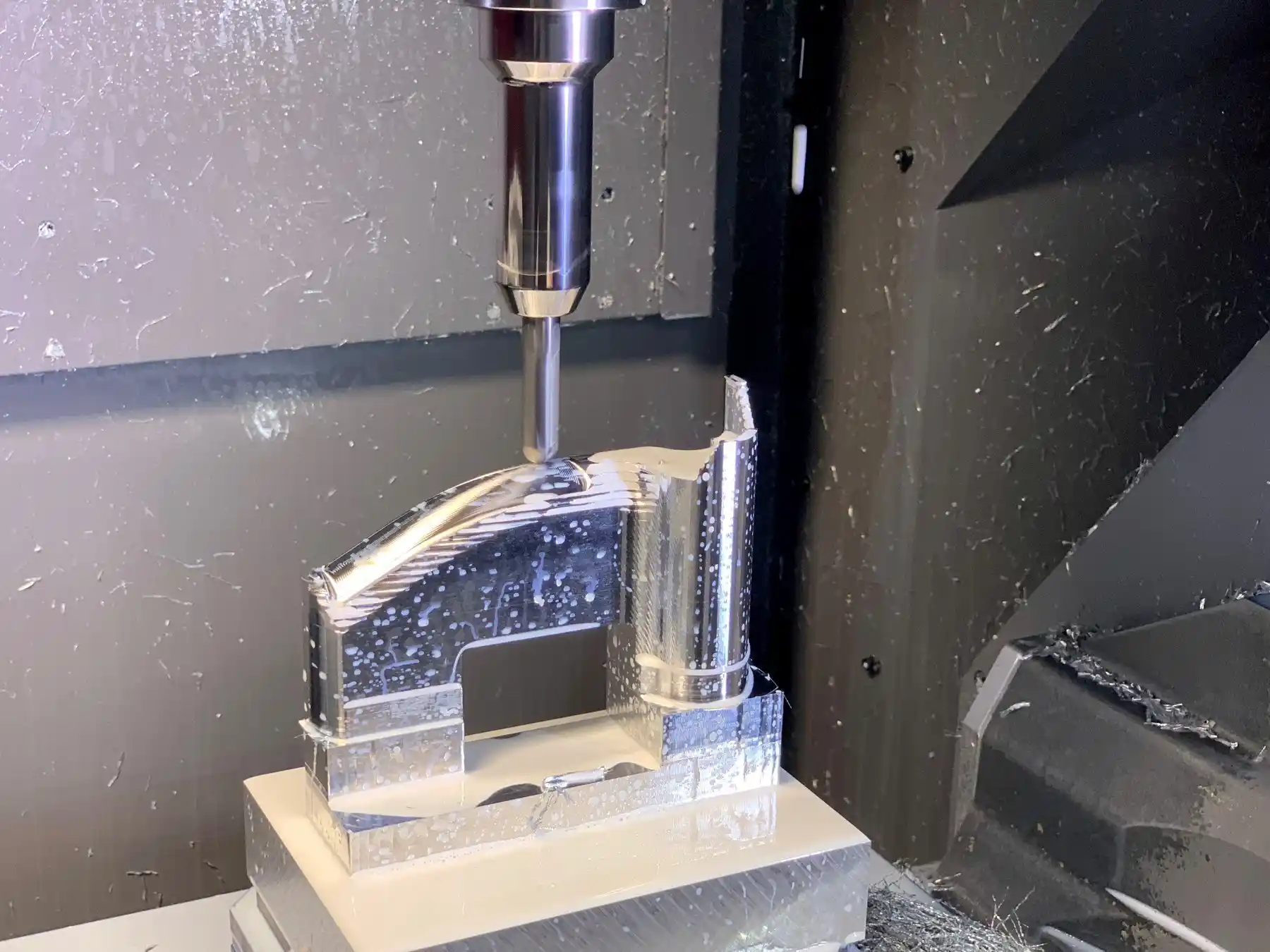
Wire EDM erodes material with a traveling wire electrode rather than a cutting edge, so hardness is not a barrier — a part can be hardened first and finished to final profile after, with no cutter deflection and no work-hardened skin to fight. That makes it the right process for keyways, broach slots, small internal corners, thin walls and any form too intricate or too hard for a mill or grinder.
We use wire EDM to finish features on parts that have already been milled or turned elsewhere on the floor — a hardened locating slot, a form tool profile, a fixture component with a sharp internal radius a rotating cutter cannot produce. Because the wire cuts a consistent kerf, tight-fitting mating parts and matched sets stay accurate across a run.
Surface finish and dimensional accuracy on wire EDM are a function of wire diameter, number of passes and material, so we quote each job against the print rather than a blanket capability claim. Send the drawing, the material and hardness, and we will tell you whether wire or a conventional process is the better fit.
- Process
- Traveling-wire EDM, through-cutting
- Best suited to
- Hardened tool steel, carbide, conductive alloys
- Typical features
- Keyways, slots, tabs, tight internal radii
- Quantities
- Single pieces to short production runs
- Wire EDM for through-cutting profiles, slots and keyways
- Support from our milling and turning departments for stock preparation
- In-house inspection for finished profile verification
- 01
Print and material review
Hardness, wall thickness and required finish reviewed against the profile before quoting.
- 02
Stock preparation
Milling or turning brings the part to a blank ready for wire cutting, including start holes where needed.
- 03
Wire cutting
Profile cut to print, with multiple passes where the callout requires a finer finish.
- 04
Final inspection
Cut profile verified against print datums before the part ships.
- Hardened tool steel (D2, A2, S7, H13)
- Stainless steel (303, 304, 316, 17-4 PH, 15-5 PH)
- Alloy and carbon steel (4140, 4340, 1018)
- Titanium (Grade 5 / 6Al-4V)
- Carbide and other conductive tooling materials
Wire EDM, answered plainly.
Can you wire EDM a part after it has been heat treated?
Yes — that is one of the main reasons to choose wire EDM. It cuts hardened material without the distortion risk of machining before heat treat and grinding after.
What is the smallest internal radius you can produce?
Internal radius is limited by wire diameter and standoff, quoted feature by feature. Send the print and we will confirm the callout is achievable.
Do you cut carbide?
Yes, provided the material is electrically conductive, which carbide grades typically are.
Is wire EDM slower than milling?
Per feature, generally yes. It earns its place on hardness, accuracy or geometry that milling cannot reach economically, not on speed.
Sinker EDM
Sinker (ram) EDM sinks a shaped electrode into the workpiece to produce blind cavities, internal splines and forms — and to remove broken taps and drills without scrapping the part.
View capability →CNC Milling
Ten vertical machining centers running prototype through production quantities, with milled features held to a standard ±.001 in and critical callouts to ±.0001 in where the print requires it.
View capability →Secondary Operations
Tapping, drilling, grinding, deburring, assembly and laser marking in-house, with anodize, passivation, plating, heat treat and NDT coordinated through approved sources.
View capability →