
Impeller Machining Services in Los Angeles
Impellers and bladed rotors machined from solid on 5-axis simultaneous trunnions, with thin-wall strategy, blade-to-blade consistency and balance addressed in process.
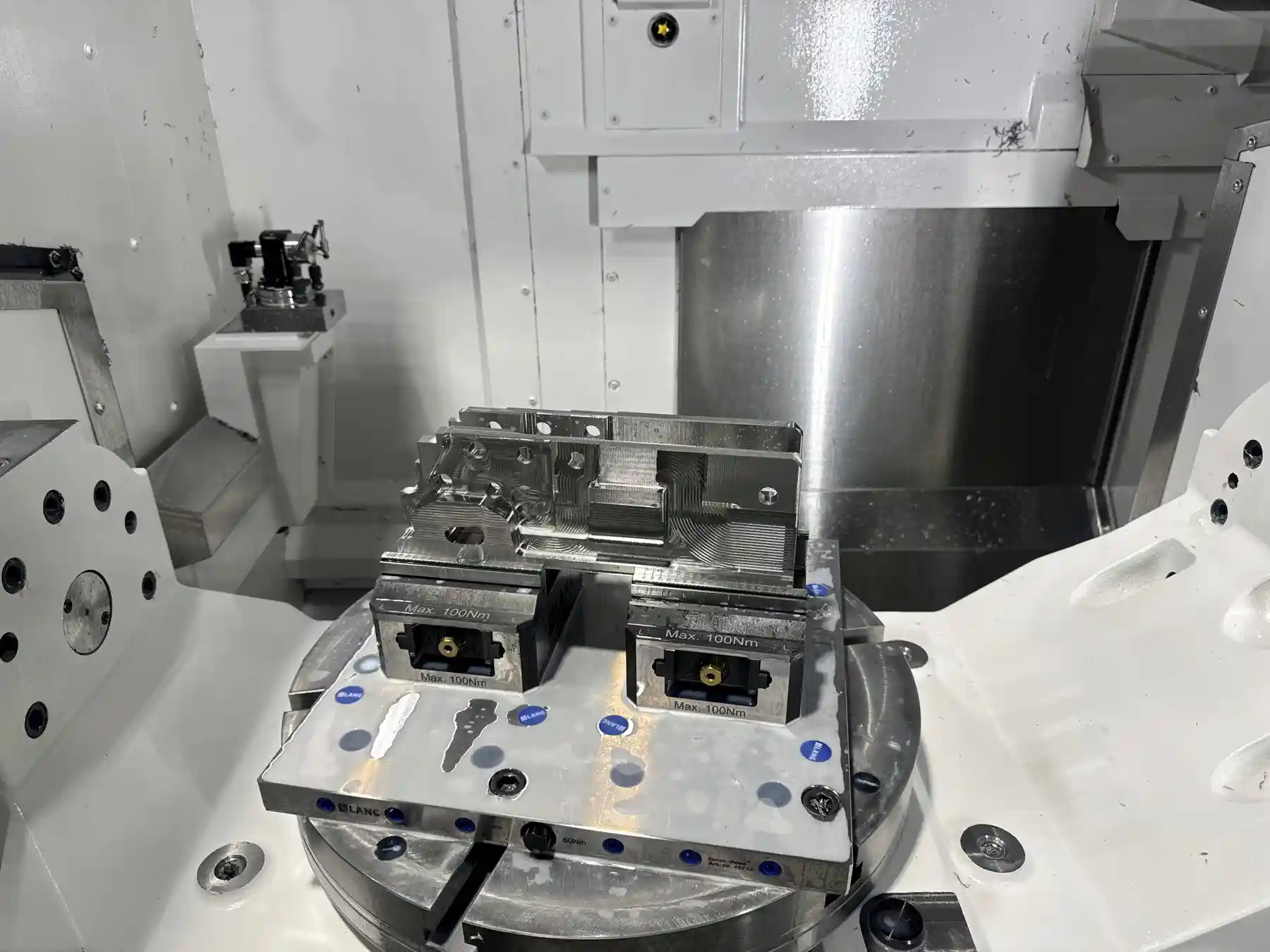
An impeller is the hardest common geometry in a machine shop. Blade surfaces are ruled or free-form in three dimensions with narrow passages between them, so the tool has to reach into a shrinking pocket at a constantly changing orientation while staying clear of the neighbouring blade — the cutter, the holder and the spindle nose all have to be checked, not just the tool tip. Blades run thin and tall, so they deflect under cutting pressure and ring at their own frequency, which shows up as chatter marks and as a leading-edge profile that walks away from the model. Every blade must match every other blade closely enough that the finished rotor runs in balance at speed, and the hub bore and face have to be concentric to the blade envelope. In titanium or Inconel, all of that happens in a material that punishes any dwell or rub.
We machine impellers on the Okuma 5-axis trunnions using simultaneous five-axis toolpaths generated and fully collision-verified against the holder and machine model before the first cut. Roughing removes bulk with trochoidal engagement and leaves an even, deliberate stock allowance so finishing sees a constant load; blades are then finished with lead and lean angles held to keep the contact point on the flank of the tool, in a blade-by-blade sequence that avoids leaving an unsupported thin wall standing next to open air. Hub features are machined in the same setup as the blade envelope wherever the geometry allows, which is what keeps concentricity from becoming a stackup. Finished rotors are verified on the ZEISS ACCURA against the CAD model — blade profile, thickness and passage geometry, blade to blade — and dynamically balanced to the print's grade through our approved partners.
- Typical materials
- 6061 and 7075 aluminum, 17-4 PH stainless, Ti 6Al-4V, Inconel 718
- 5-axis capacity
- 20 in dia. × 14 in high on the trunnion
- Turned diameters
- ±.0005″
- Milled features
- ±.001″
- Critical features
- ±.0001″
- Surface finish
- 16 Ra standard · 8 Ra on request
- Secondary operations
- Dynamic balancing, polishing, anodize, NDT
- Verification
- Blade profile scanned to CAD on the ZEISS ACCURA
- Okuma MU-5000V 5-Axis Vertical — Ø27.56″ × 19.69″ machining volume
- Okuma Genos M560V-5AX 5-Axis Vertical simultaneous machining
- Okuma M460-5X 5-Axis Vertical — X 28.7″, Y 18.1″, Z 17.7″
- Haas UMC-500 5-Axis Universal Machining Center
- DMG MORI NLX 2500SY/700 turning center for hub and bore work
- ZEISS ACCURA CMM with surface scanning against the CAD model
- Aerospace
- Defense
- Power generation
- Oil and gas
- Motorsport
More on the programs we support in industries, the inspection methods behind these parts in quality, and the stock we run in materials.
Impeller Machining, answered plainly.
Do you machine impellers from solid or from castings?
Both. Machining from solid billet is the usual route for prototypes, low volumes and blisk-style rotors; cast or forged blanks are machined to finish where the program supplies them.
How do you avoid chatter on thin blades?
Roughing leaves an even stock allowance so finishing load stays constant, blade finishing follows a sequence that never leaves an unsupported thin wall standing alone, and lead and lean angles are controlled so the contact point stays on the tool flank.
Can you balance a finished impeller?
Yes. Dynamic balancing to the print's balance grade is handled through our approved partners, with the balance report returned alongside the CMM report for blade profile and hub concentricity.
5-Axis Machining
Five simultaneous 5-axis machining centers for impellers, contoured housings, brackets and any part where every additional setup is another chance to stack error.
View page →Inconel Machining
Inconel 625 and 718 machined, EDM'd and inspected in-house, with tooling and feeds built around a nickel alloy that hardens under the cut.
View page →Aerospace Machining
Structural brackets, fittings, manifolds and contoured housings machined under an AS9100D quality system, with first-article inspection and material traceability on every release.
View page →Send us the part, not just the part number.
Complete what you have and we will come back with questions on the rest. Please do not paste drawings or ITAR / export-controlled data here — we will arrange secure transfer.
Need the full package form? Full RFQ form · Contact us