
Turning with the milling built in.
Eight turning centers, several with Y-axis and sub-spindle, so a chucked part is turned, milled, drilled and finished on the back side without leaving the machine.
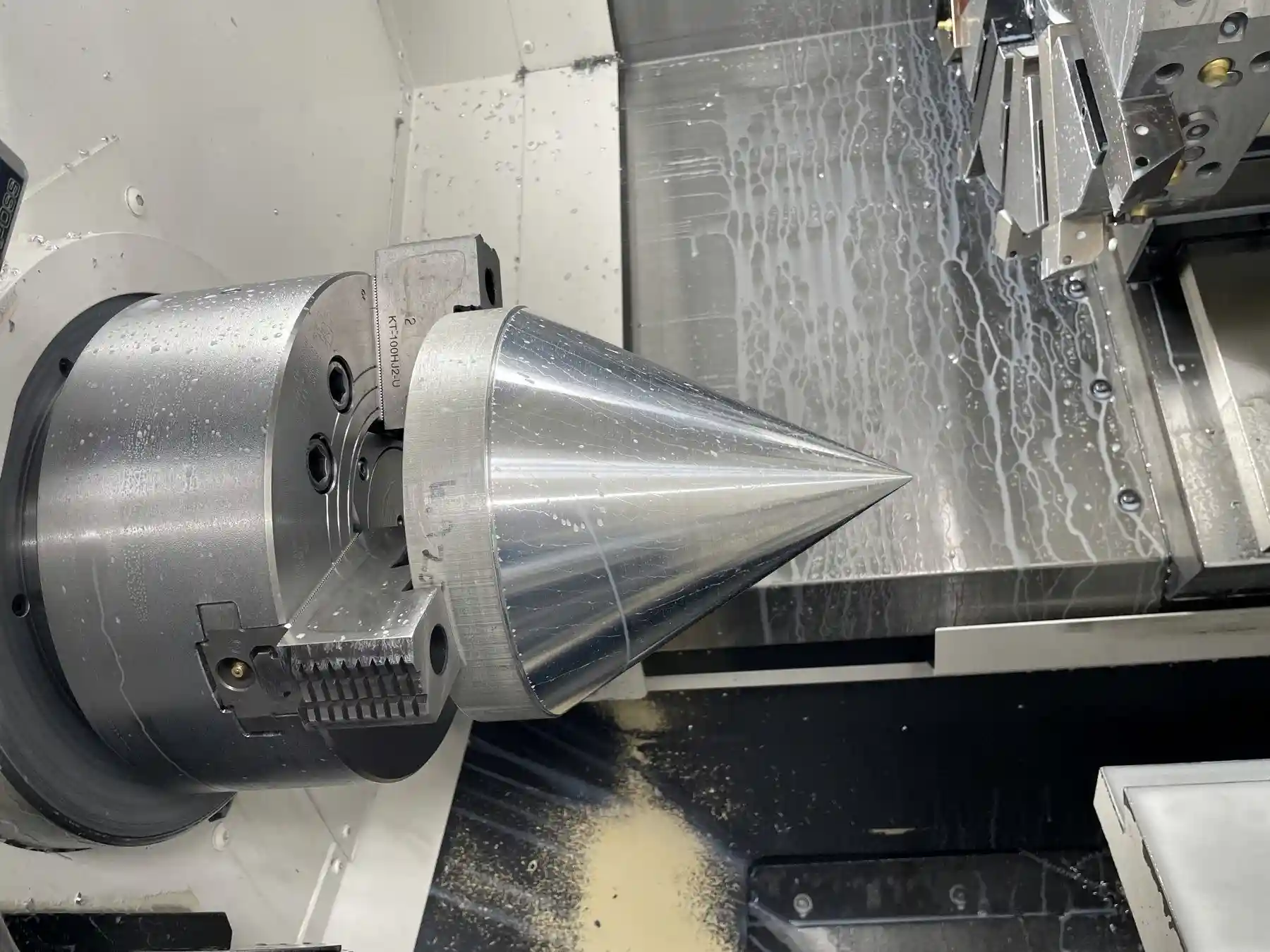
Chucked work larger than bar capacity runs here: flanges, hubs, adapters, rings, spindles and housings. The Okuma Genos L400II-E handles the heavier envelopes; the DMG MORI NLX 2500SY/700 and NL1500SY/500 bring Y-axis and sub-spindle for done-in-one parts; the Takisawa TCC series and Haas ST-10 and SL-10 cover the middle of the range.
Contour, form, taper and straight turning, single-point threading, grooving, boring and off-center milled features. Because the second operation happens on the sub-spindle, the front-to-back relationship is held by the machine rather than by a re-chuck.
Turned diameters are held to a standard ±.0005 in, with critical features to ±.0001 in when the print calls for it — verified against print datums on the CMM before shipment.
- Standard turned tolerance
- ±.0005″
- Critical features
- ±.0001″
- Max turning diameter
- Up to 12 in dia.
- Max turning length
- Up to 28 in between centers
- Capabilities
- Y-axis milling, sub-spindle, threading, boring
- Okuma Genos L400II-E — heavy-duty CNC turning center
- DMG MORI NLX 2500SY/700 — Y-axis, sub-spindle
- DMG MORI NL1500SY/500 — Y-axis, sub-spindle
- Takisawa TCC series turning centers
- Haas ST-10 and SL-10 — small to mid-envelope turning
- 01
Workholding review
Chuck, collet or soft jaws selected so clamping does not distort a thin-walled part.
- 02
Done-in-one programming
Front and back operations combined on the sub-spindle where the geometry allows.
- 03
First article
Dimensional report against print datums before the balance runs.
- 04
Final inspection
Critical diameters and geometric callouts verified on the CMM.
- Aluminum (6061, 7075, 2024)
- Stainless steel (303, 304, 316, 17-4 PH, 15-5 PH)
- Alloy and carbon steel (4140, 4340, 1018)
- Titanium (Grade 5 / 6Al-4V)
- Inconel® and nickel alloys
- Brass, bronze and copper
- Engineering plastics (Delrin®, PEEK, PTFE)
CNC Turning, answered plainly.
What is your maximum turning diameter?
Up to roughly 12 in in diameter and 28 in in length depending on the machine and workholding.
Can you do turning with milled features?
Yes — Y-axis and sub-spindle machines cut flats, slots, keyways and off-center holes without a second setup.
Do you offer outside processing?
Yes. Anodize, passivation, plating, heat treat and NDT are coordinated through approved sources and documented on the shipment.
Swiss Turning
Sixteen Swiss-type lathes — Citizen L12, L20 and L32, Citizen/Miyano BNX and BNA, Tsugami S205-II and B0325V-II — holding ±.0005 in on turned diameters with as-machined finishes that rarely need a secondary operation.
View capability →CNC Milling
Ten vertical machining centers running prototype through production quantities, with milled features held to a standard ±.001 in and critical callouts to ±.0001 in where the print requires it.
View capability →Secondary Operations
Tapping, drilling, grinding, deburring, assembly and laser marking in-house, with anodize, passivation, plating, heat treat and NDT coordinated through approved sources.
View capability →