
Swiss-Type Turning: How 16 Citizen and Tsugami Machines Hold Tenths on Micro Parts
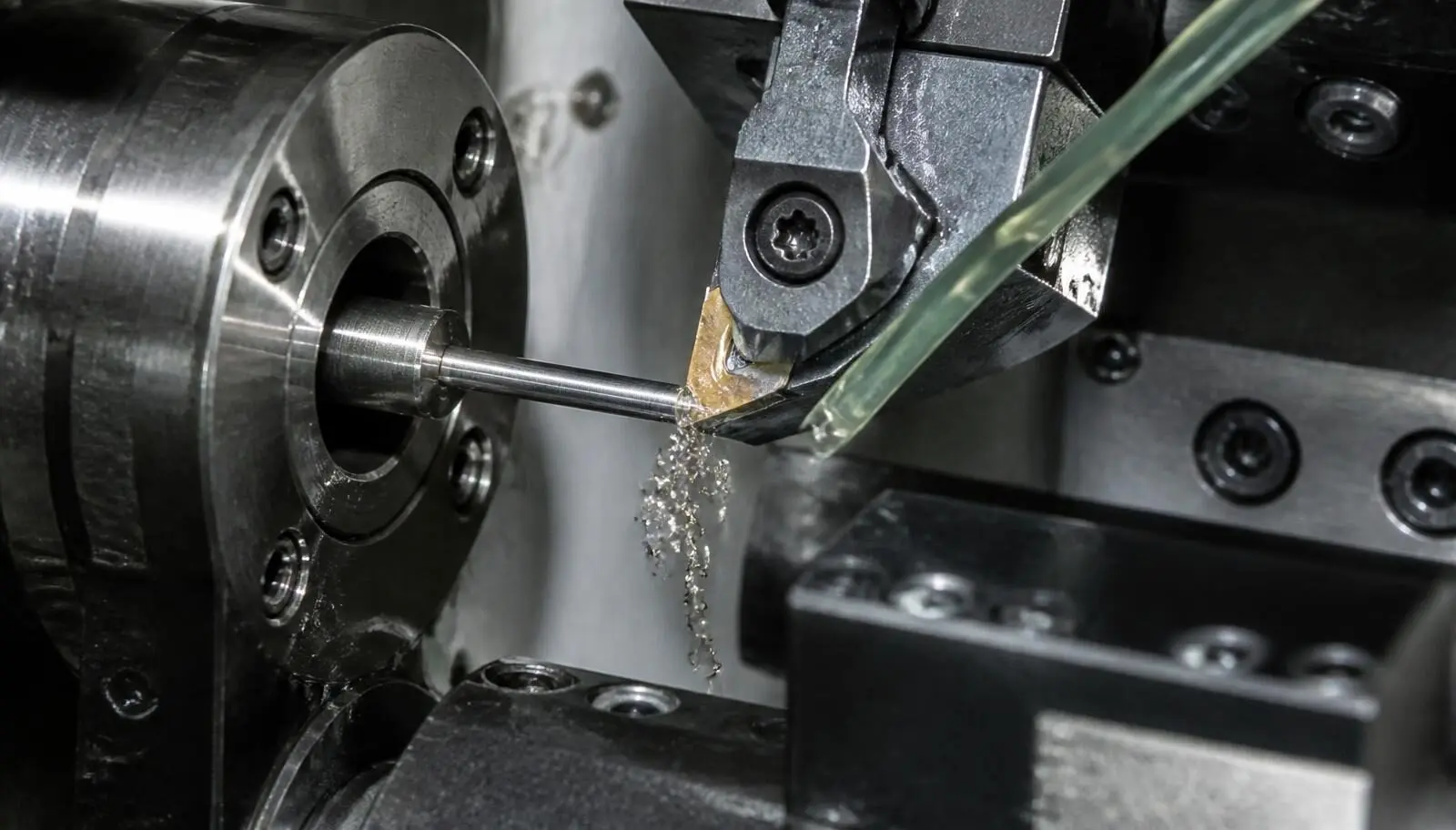
Guide bushing support, sub-spindle pickoff and 16 Swiss-type lathes are what make ±0.0002 in. diameters repeatable across a 50,000-piece run instead of lucky on one.
Swiss-type turning is the discipline most often misunderstood by engineers releasing a small, slender part for the first time. A conventional turning center grips stock in a chuck and cuts it in cantilever; deflection grows with every diameter of overhang. A Swiss-type lathe instead feeds bar stock through a guide bushing, and the cutting tool works within a fraction of an inch of that support. The unsupported length never changes, so the part does not know how long the bar behind it is.
That single difference is why RJ runs 16 Swiss-type machines — Citizen L12, L20X, L32 VII, A32V11PL, BL-12, Citizen/Miyano BNX-51MSY, and Tsugami S205-II and B0325V-II among them — rather than pushing slender work through standard chuckers.
Where Swiss earns its keep
- Length-to-diameter ratios above 4:1. Shafts, pins, dowels, electrode bodies and probe stems that would chatter in a chuck cut cleanly against a guide bushing.
- Diameters under 32 mm. RJ's Swiss envelope covers 12 mm through 32 mm bar, which is where most medical, connector and instrument work lives.
- Tolerances in tenths. Diameters held to ±0.0002 in. and concentricity under 0.0005 in. are production expectations on these machines, not exceptions.
- Complete parts off one machine. Live tooling and a sub-spindle mean cross holes, flats, threads, knurls and backside features finish before the part drops into the parts catcher.
Why the sub-spindle matters more than the spindle
A part that transfers to a sub-spindle for its backside work never gets re-gripped by a human. Every datum relationship between the front and back of the part is established by the machine, in one cycle, under the same thermal conditions. On a 20,000-piece order that removes the single largest source of drift: operator-to-operator setup variation on a second operation.
For the customer, that shows up as a shorter first-article cycle and a capability index that holds through the run rather than degrading in the last third of it.
Material behavior sets the process, not the print
The same geometry in three materials is three different jobs:
- 303/304 stainless work-hardens, so feed must stay committed; dwelling at the tool is what glazes the surface.
- 17-4 PH in H900 condition cuts predictably but is hard on inserts; tool life drives the cost model more than cycle time does.
- Titanium 6Al-4V demands high-pressure coolant at the cutting zone and conservative surface speed to keep heat in the chip instead of the part.
- Brass and aluminum run fast enough that the constraint moves to bar-feed and chip control, not the cut.
What to send with an inquiry
Send the model and the print together, and call out which diameters are functional and which are cosmetic. On Swiss work, a tolerance tightened "just to be safe" often forces a slower pass, an extra inspection gate, or a second finishing tool — cost that buys nothing if the feature never mates with anything.
RJ quotes Swiss work from the print with the machine already chosen. If a part is better as a turned-and-milled job on a Genos L400II-E or a DMG MORI NLX 2500SY than as a Swiss part, we will say so in the quote.
What an AS9102 First Article Inspection Report Actually Contains
A form by form walkthrough of the AS9102 first article inspection report: balloon drawings, characteristic accountability, how the report is built from CMM data, why primes reject packages, and when a delta FAI is required.
Design for Manufacturability for Swiss Turned Parts
Practical design guidance for Swiss turned components: guide bushing and bar diameter limits, length to diameter ratios, internal corner radii, thread relief, which tolerances genuinely need tenths, finish callouts and materials that run well.
CNC West Feature: From Legacy Widgets to 5-Axis Leadership
CNC West Magazine visited RJ Enterprises for a profile of the shop's move from single-customer legacy work to simultaneous 5-axis and mill-turn production, capital investment strategy and the road toward lights-out manufacturing.