
CNC Turning or Swiss Turning? Choosing the Right Process for Custom Shafts and Bushings
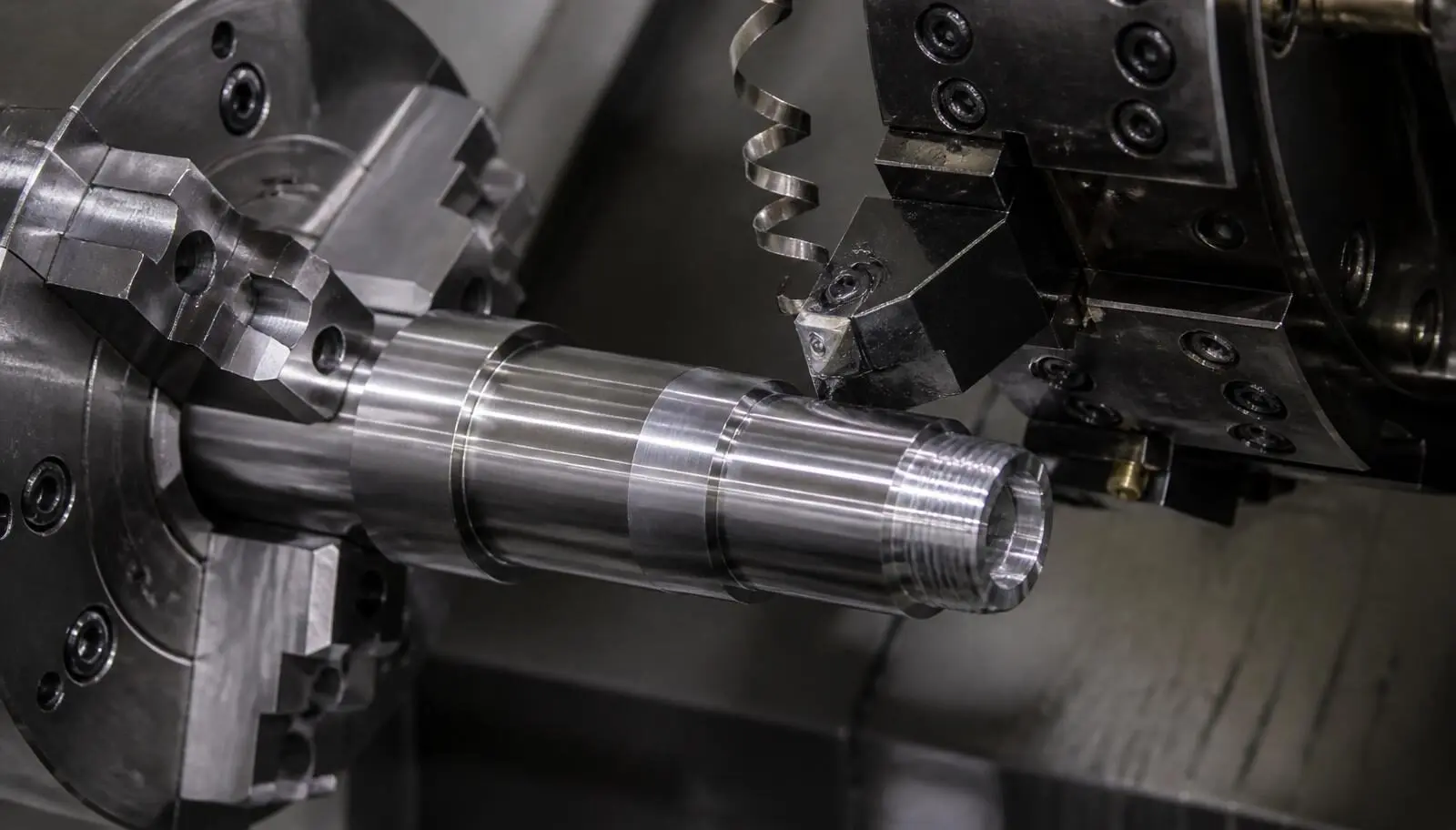
Bar diameter, length-to-diameter ratio and quantity decide the process. Getting that decision right at quote time is usually worth more than any cycle-time optimization later.
Most custom shafts, bushings, spacers and adapters can be made two ways at RJ: on a CNC turning center with a chuck and bar puller, or on a Swiss-type lathe with a guide bushing. The parts come out to the same print. The cost, lead time and process risk do not.
The four questions that decide it
- What is the bar diameter? Above roughly 32 mm, the work belongs on a turning center — Okuma Genos L400II-E, DMG MORI NLX 2500SY/700, NL1500SY/500, Takisawa TCC-2000 L3 or Haas ST-10. Below it, Swiss becomes viable.
- What is the length-to-diameter ratio? Beyond about 4:1 of unsupported length, chatter and taper start eating the tolerance. A guide bushing removes that ceiling.
- How many pieces, and how often? Swiss setups reward volume and repeat orders. A 25-piece prototype in 1.5 in. stainless is usually faster and cheaper on a turning center.
- How much secondary work is on the print? Cross holes, flats, hex features, off-center bores and backside threads finish in-cycle on Swiss and on Y-axis/sub-spindle turning centers. If they cannot, they become a milling operation and a second inspection gate.
Where turning centers win outright
Large flanged parts. Heavy-wall bushings. Anything requiring a big bore, deep drilling with a substantial drill, or serious material removal per pass. Y-axis and sub-spindle machines such as the NLX 2500SY handle turn-mill hybrids — a turned body with milled pads and off-axis holes — complete, without a trip to a vertical machining center.
Where the two overlap, and how RJ decides
In the 20 mm to 32 mm band with moderate L:D and quantities in the hundreds, both processes work. The tiebreakers are practical:
- If the part repeats quarterly, Swiss amortizes better and the process is more stable across lots.
- If the part is one-and-done, turning avoids Swiss setup and bar preparation.
- If concentricity between front and back features is critical, whichever machine can do both ends in one cycle wins.
Design details that change the cost
- Undercuts and sharp internal corners force a form tool or a grooving pass. Allowing a small radius often removes both.
- Blanket tolerances. A ±0.0005 in. note applied to every diameter turns a one-tool finishing pass into a measured, gated process on all of them.
- Surface finish callouts below 16 Ra may require an added finishing operation. Specify them only where function demands it.
- Thread specs. Rolled, cut or single-point threads carry different tool and cycle costs; naming the standard is enough, we will pick the method.
Send the print and the annual quantity. RJ quotes the process, not just the part — and the quote states which machine the job is planned for.
What an AS9102 First Article Inspection Report Actually Contains
A form by form walkthrough of the AS9102 first article inspection report: balloon drawings, characteristic accountability, how the report is built from CMM data, why primes reject packages, and when a delta FAI is required.
Design for Manufacturability for Swiss Turned Parts
Practical design guidance for Swiss turned components: guide bushing and bar diameter limits, length to diameter ratios, internal corner radii, thread relief, which tolerances genuinely need tenths, finish callouts and materials that run well.
CNC West Feature: From Legacy Widgets to 5-Axis Leadership
CNC West Magazine visited RJ Enterprises for a profile of the shop's move from single-customer legacy work to simultaneous 5-axis and mill-turn production, capital investment strategy and the road toward lights-out manufacturing.